
Norwalk Criminal Court Cases
Connecticut abolished county government, so there is no Norwalk county clerk or county criminal court. Norwalk matters run through the Stamford–Norwalk Judicial District Superior Court. Part B generally handles misdemeanors, infractions, motor-vehicle matters, and Class C, D, and E felonies. Part A primarily handles Class A and B felonies and other serious matters assigned to that docket.
The Judicial Branch clerk keeps the court file. Norwalk Police keeps the incident narrative, Uniform Arrest Report, booking media, and evidence records. Those are related but distinct sources. A court docket answers what charge the prosecutor filed and how a judge resolved it. It does not replace the police report or the identity-linked history held by the State Police Bureau of Identification.
Norwalk Cases Go to Stamford
Current Norwalk criminal work is heard at 123 Hoyt Street in Stamford. The former G.A. 20 courthouse at 17 Belden Avenue is closed for general criminal business, although that Norwalk address remains an Adult Probation office. Calling the active clerk before travel avoids a common wrong-building trip.
Stamford–Norwalk Superior Court
123 Hoyt Street
Stamford, CT 06905
Public information: 203-965-5308
Criminal clerk: 203-965-5208
The Judicial Branch directory gives current court contacts. Ask whether a public file can be inspected, mailed, emailed, or ordered as a plain or certified copy. The clerk, not the legacy building label, controls access to the current file.
Searching Norwalk Case Records
Search both the pending criminal case lookup and the disposed case lookup. They are free and require no public account. Use an exact legal name, then narrow carefully. A legacy Norwalk G.A. 20 choice may appear even though present court operations route through Stamford.
- Open the pending index first when the matter may still be active, then repeat the search in the disposed index.
- Enter the last name and first name or initial. Add birth year when available to distinguish common names.
- Check Stamford and any relevant legacy Norwalk location. A full docket number provides the strongest match.
- Open the case detail and compare arrest date, statute, court, status, and disposition, rather than relying on a name alone.
- Contact the Hoyt Street criminal clerk for inspection, certification, or a paper the index summarizes but does not supply.
| Field Label | Type | Required | Notes |
|---|---|---|---|
| Last name | Text | Yes for name search | Use the legal surname and test a known spelling variant. |
| First name or initial | Text | Yes | Narrows pending and disposed results. |
| Birth year | Number | No | Helps separate people with the same name. |
| Location | Select | No | Review Stamford and a relevant Norwalk legacy choice. |
| Docket number | Text | Alternative | Use the complete court identifier when known. |
The Norwalk G.A. 20 Trap
G.A. 20 can survive in a portal menu or old docket even though its Belden Avenue courthouse is no longer the active criminal counter. That label records the case's geographical-area history. It does not promise that the physical Norwalk courthouse is open. Preserve the docket number, inspect the listed status, and confirm the file location with the Stamford clerk.
This distinction matters most for old disposed cases. The Stamford–Norwalk Judicial District began in 1981, and a docket can reflect the court structure in place when a matter started. A location mismatch does not alone mean the result is wrong. The full docket identifier is more useful than a copied party name.
Part A and Part B are assignments within Superior Court, not separate local courts. Part B commonly receives Norwalk misdemeanors and lower felony classes. A serious charge may proceed in Part A. The index's court and case-type fields help establish which clerk desk owns the record.
Note: Adult Probation still operates at 17 Belden Avenue, but it is not the general criminal records counter.
Inside a Norwalk Case File
A public case detail can connect the court, charges, events, and outcome. It may identify counsel and the prosecuting authority, show bond or failure-to-appear information, and report a sentence after conviction. The online index is not a complete bundle of downloadable filings. Ask the clerk for the charging paper, judgment, or certified disposition when the document itself matters.
| Case number and court | The unique docket identifier, location, case type, and status. |
|---|---|
| Charging information | Filed counts, statutes, descriptions, and original or amended charges. |
| Docket events | Arraignment, plea, continuance, motion, hearing, trial, and judgment entries. |
| Disposition | Conviction, dismissal, acquittal, nolle, or another public result by count. |
| Sentence | Effective and suspended terms, probation, fines, and public conditions. |
| Bond or warrants | Public bond status and failure-to-appear or rearrest information when shown. |
Norwalk Dockets Are Not PDFs
The state lookup is a case index. It does not guarantee a free PDF of the information, complaint, motion, plea form, or judgment. Give the criminal clerk the complete docket number and identify the exact paper needed. Ask about inspection, ordinary copies, certification, and delivery before ordering. The reviewed official sources did not establish a current copy or certification fee, so confirm cost instead of assuming a rate.
For an NPD narrative, booking image, body-camera file, or police evidence, use Norwalk Police. The court clerk and police records unit do not hold interchangeable files.
The official courthouse capture below comes from the Judicial Branch's Stamford location page.
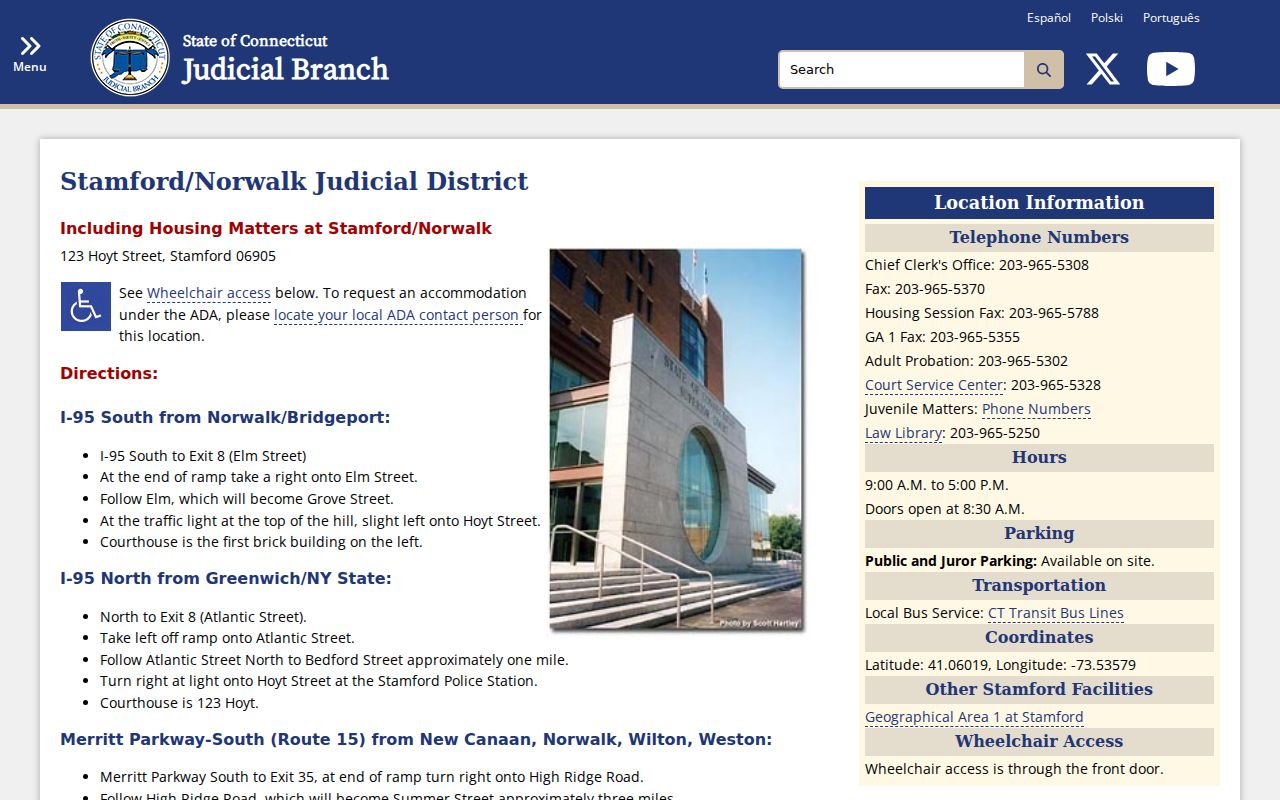
It confirms that current Norwalk court access centers on Stamford rather than the closed G.A. 20 building.
How a Criminal Case Moves
A police arrest begins a local record, but prosecutors decide what charge enters court. The accused appears for arraignment, where the charge is stated and a plea may be entered or deferred. Pretrial dates can include discovery, negotiations, motions, and hearings. The case then ends by plea, trial, dismissal, acquittal, or nolle. A conviction proceeds to sentencing.
Case flow: Charges Filed › Arraignment › Pretrial › Plea or Trial › Disposition › Sentencing
- Nolle prosequi
- The prosecutor declines to continue the charge at that time. It is not a conviction.
- Disposition
- The outcome for a charge, such as conviction, dismissal, acquittal, or nolle.
- Part A
- The Superior Court docket generally used for more serious felonies.
- Part B
- The docket generally used for lower felonies, misdemeanors, infractions, and motor-vehicle matters.
Older Norwalk Court Dockets
Connecticut's online conviction display is generally limited to ten years after sentencing and can be shorter under court retention rules. That online window is not a ten-year limit on a full criminal history. An older Norwalk case may require a clerk or archive inquiry even when the public search returns nothing.
Start with a docket number, approximate year, legal name, and known location. Explain that the matter may have originated under Norwalk G.A. 20. The clerk can state whether a public file survives, where it is stored, and what copy options apply. Absence can also reflect erasure, sealing, youthful-offender status, or a name error.
The disposed-case capture shows the state search used before escalating to the clerk.
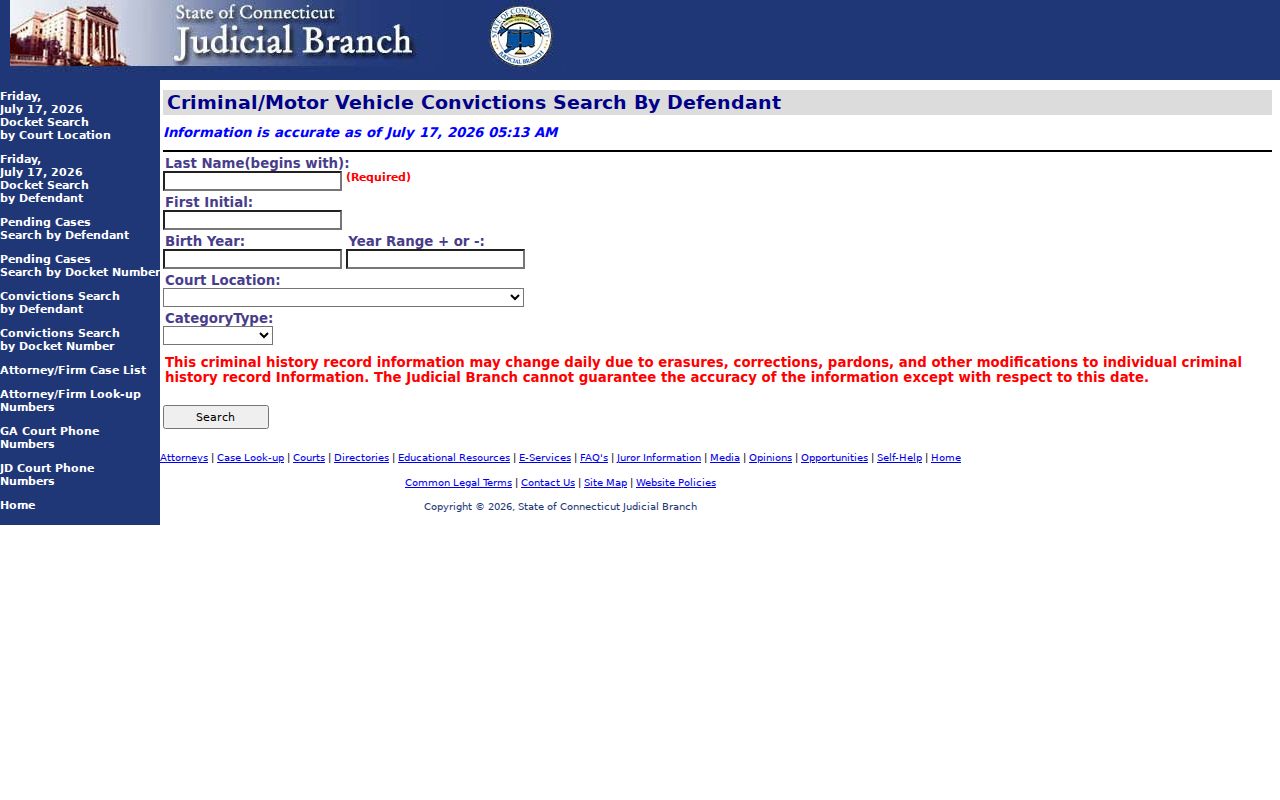
The result is an index entry. The originating clerk remains the source for an official copy.
Case Record Access & Restrictions
Public access does not expose every field. Full birth dates, Social Security numbers, financial data, protected victim or minor details, and confidential youthful-offender information are restricted. Sealed and erased matters do not appear as ordinary public cases. Under Connecticut criminal-record law, dismissed charges, acquittals, and qualifying nolles can be erased.
If a Norwalk case is missing, check both state indexes and verify spelling, birth year, location, and docket number. Then call the clerk. Staff may confirm that no public result is available without disclosing protected content. A paper file is not a way around sealing or erasure.
Federal prosecution is a separate layer. PACER holds District of Connecticut dockets and uses an account and federal fee policy.
PACER does not replace the Connecticut Judicial Branch search for a state prosecution.
Court File vs. NPD Report
A Norwalk Police report and a Superior Court file can describe the same event without matching word for word. The Uniform Arrest Report records the arresting officer's allegations, identifiers, probable-cause route, and release details. The prosecutor may file fewer counts, substitute a statute, or decline a charge. The docket then tracks only the case that entered court.
For the police side, request the public arrest record from NPD and ask separately for the incident report or media. For the court side, search the pending and disposed indexes, then obtain the charging paper or disposition from the clerk. Match the case number, docket number, dates, and statutes. A changed court charge is not proof that either record is corrupt. It may show the normal charging process.
NPD later receives court outcomes and updates its arrest entries with terms such as Guilty, Nolle, and Dismissed. That update helps, but the court remains the source for the legal disposition. To correct a mismatch in one's own record, collect both documents and contact the custodian of the incorrect field.